Procurement note
The $3,800 Wrong-Hardness Order That Reset My Polyurethane Roller Sourcing Process
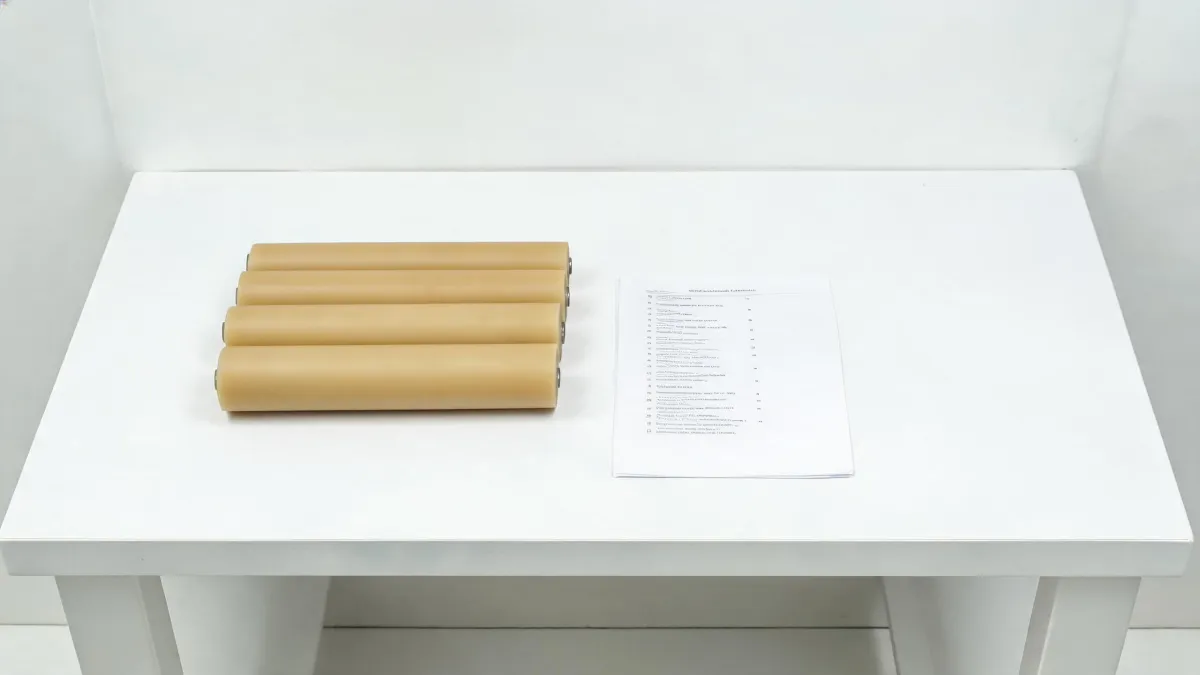
When a Pallet Shows Up Wrong
It was a Tuesday morning in March 2023, just before 7 a.m., and I was standing in our receiving bay staring at a pallet of 24 polyurethane rollers catching the early light. They looked fine. Smooth, consistent color, clean edges. Then our maintenance lead walked over, tapped one with his knuckle, and shook his head.
"These are 85A," he said. "The print says 95A."
I checked the spec sheet. He was right. The order said 95 Shore A. The supplier shipped 85. That's not a small gap — on a high-speed packaging line it's the difference between a roller that performs and one that deforms under peak load. And we had a Friday shipment to hit with no spare parts on the shelf.
That's about the point I realized I hadn't actually understood what I was buying.
Why I Never Looked Too Closely
I run procurement for a 180-person company. That's the whole job — keeping total spend sensible. By the end of 2022 I had roughly $600,000 in cumulative procurement spend rolling through my log across four years. Rubber and plastic components were a small slice of that annually, and polyurethane rollers had always been one of those line items I signed off without thinking too hard about.
It took me about three years and something like 60 related purchase orders to understand that the price per roller tells you almost nothing. What actually matters is how many cycles each roller survives between maintenance intervals — and that number isn't remotely connected to the number on the quote sheet.
Looking back it's easy to say. But at the time I was running every procurement through the same process: three quotes, pick the cheapest, set a calendar reminder for the next reorder. That worked fine for fasteners and shop consumables. It fell apart completely on polyurethane rollers.
What I Thought the Benefits Were
If you search for the advantages of polyurethane rollers, you'll get a wall of content about abrasion resistance, oil resistance, load capacity, and resilience, plus the usual polyurethane-vs-rubber-vs-silicone-vs-steel comparison tables. All of that is true. Polyurethane does typically outlast rubber in wear-heavy and oil-exposed environments. Load capacity holds up. Its ability to survive cuts and gouges is usually better than what you get from rubber-based rollers.
But "benefits" is a broad word. What actually changes outcomes is which of those benefits your line cares about.
On our packaging line, ranked by how often they caused failures, the top three pain points were:
- Surface deformation on edge guides under load
- Material aging from sustained heat exposure
- Cuts and gouges from debris particles
So for our application, the actual benefit we needed to pay for was the combination of hardness, heat rating, and surface finish. Not maximum hardness. Not oil resistance. Those 85A rollers were almost perfect on every dimension except the one that mattered.
And the reason that happened is embarrassingly simple. My RFQ form had a spec line that said, "Hardness: polyurethane, standard."
That spec line is why a $3,800 mistake showed up at my loading dock on a Tuesday morning.
The Lucky Failure I Walked Into
Here's the part that still stings. I knew I should have confirmed the hardness spec in writing before the order went out. But I'd worked with that supplier for three years without an issue, and I told myself "what are the odds?" That was the one time the odds caught up with me.
Direct cost on that bad batch was around $3,800 — the rush re-make, expedited shipping, rework hours, and line downtime inside the Friday shipment window. That number doesn't include the revenue we missed by shipping a day late.
What bothered me more was the fact that none of it was necessary. Two extra lines on a purchase order would have prevented the whole thing. I skipped them because I was busy and the supplier had never missed before. The assumption that "it never matters" is what cost us.
The Decision I Almost Got Wrong
Not everything was a screw-up. In Q4 2022 we almost switched polyurethane roller suppliers over a price difference, and I'm still relieved we didn't.
I had two quotes for the same nominal spec. One came in at $118 per roller, the other at $104. That's $14 per unit, which across our annual volume was roughly $3,360 in theoretical savings. On paper, easy call.
Then I pulled the total cost of ownership apart. The cheaper quote didn't include hardness verification, had no documented cure process, and gave a delivery estimate of "4 to 6 weeks, subject to schedule." The higher quote included material certification and a three-week lead time. Our downtime cost is roughly $1,800 per day. One missed delivery on the cheaper quote would have wiped out the entire annual savings.
We stayed with the higher quote. Not because it was better in some abstract sense — it was probably the more conservative call — but because the savings on the other side weren't large enough to justify the variable.
The turning point came after the March 2023 incident. Our updated procurement policy now requires that every polyurethane roller spec has at least two written confirmation points — hardness plus material grade under ASTM or equivalent — before a purchase order goes out, regardless of how long the supplier has been around. Load-bearing rollers also need load data and cure documentation on file.
Rework rates dropped after that. Not to zero, because nothing reaches zero, but the majority of incorrect-shipment incidents dropped off the books.
What I Actually Ask Polyurethane Roller Suppliers Now
If someone asked me which questions to ask first when sourcing polyurethane rollers, price wouldn't be on the list. I'd start here:
- Which polyurethane system is this? Cast, machined, or thermoplastic — the failure modes are completely different.
- What is the hardness value, and how is it verified? Shore A and Shore D are not interchangeable, and "standard polyurethane" is not a spec.
- What does your cure process look like? Under-cured rollers run shorter and fail quietly. That cost isn't on the tag.
- What are your tolerances? A roller outside spec can add $200 to $400 in rework per unit before you even notice the invoice.
- Can you send it in writing? Not a catalog page. A material certificate tied to our order.
Five questions. None of them about unit price. All of them about what that unit price actually means.
What Actually Changed in My Thinking
After about four years and somewhere north of 60 procurement orders, I've come to believe that in polyurethane roller sourcing, the cheapest quote is almost never the cheapest order.
That conclusion isn't new, and I'm aware of that. But there's a difference between knowing something you read and knowing something you paid for. I paid for this one.
The old fundamentals still hold — get three quotes, document your decisions, verify specs. Those aren't going anywhere. What's changed is that I now know which specs to push on first, and why a "good" price without a written acceptance criterion might not be a good price at all.
What worked in 2020 doesn't really work in 2026. Not because polyurethane changed, but because the procurement teams I talk to now have more data available to them, and the suppliers are being judged against it. If you let vendors decide "standard polyurethane" is a sufficient spec, you'll pay more than you should — on some quote, eventually, in some way that doesn't show up on the invoice.
It took me years to figure that out. I'd rather you didn't need to.